I’m Still Here

…just keeping busy in Editing Hell.

I have one word and one phrase I’ve been caught overusing. Once I finish searching for those and cutting or rewriting, I’ll have myself a FINAL DRAFT.

Then I just have a few files of notes to go through, to make sure I’ve done everything I meant to do before this thing can be sent off for formatting and cover art.

Here’s a great New York Times article I found through The Passive Voice. It was published in 2001 but it has some of the most straightforward writing advice I’ve found. Here’s the best part:

If it sounds like writing, I rewrite it.

Or, if proper usage gets in the way, it may have to go. I can’t allow what we learned in English composition to disrupt the sound and rhythm of the narrative. It’s my attempt to remain invisible, not distract the reader from the story with obvious writing. (Joseph Conrad said something about words getting in the way of what you want to say.)

–Elmore Leonard, WRITERS ON WRITING

But you should really read the whole article.

Here’s a great quote from Hugh Howey, author of WOOL, in an interview on A Newbie’s Guide to Publishing:

As for the 99.9% who won’t see my level of success, I would point out that 99.9% of those who submit material to the traditional machine will never see a similar level of success. It isn’t like our option is to self-publish OR see how well our novel does fronted out on an endcap in a bookstore. Our options are to self-publish OR spend a few years landing an agent, another year selling the book to a publisher, a year waiting for that book to come out, and then three months spine-out on dwindling bookshelves before you are out of print and nobody cares about you anymore. If you’re lucky. Most likely, you’ll never even get an agent. Because you aren’t Snooki.

–Hugh Howey

And one more, but I can’t remember where I found it:

“Listen, Hank,” he asked, “what makes a man a writer?” “Well,” I said, “It’s simple, it’s either you get it down on paper or you jump off a bridge.”

–Charles Bukowski
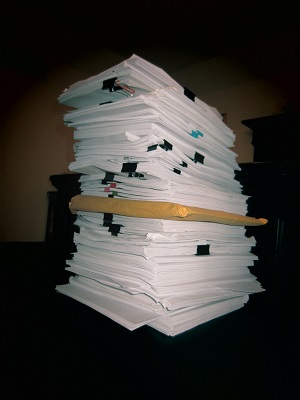
This is Three Years

As Craig Nova calls it, this is my “slag heap” generated during the past 3.83 years. I keep mine divided and tucked safely into two dresser drawers. An innocent stack on a desk like Nova’s pictured in the article is easy prey for either my cats or my two-year-old.

stack

In the article linked above, Craig Nova discusses the act of rewriting to better understand your story. He also mentions every novel has a stopping point.

I would like to add one warning here. Or make that two. You do come to the point of diminishing returns, and at that point it is time to stop. You have what you are going to have, and that’s that. After a certain point, the novel will get worse the more you write.
–Craig Nova

I think I’ve reached that point.

I’m finishing my read-aloud (if you haven’t done this, you should, but it requires a very patient and tolerant partner). We’re a few chapters from the end. Once all those edits get applied, I’ll shoot it off to one more reader (if she’s still willing!). Her feedback will create a few more edits, hopefully minor, and then I have a final version. I’ll probably read it one more time to satisfy my writer’s OCD.

Then, hands off.

TOO BAD IT WILL NEVER TURN OFF IN MY HEAD. I looked for a raisin face meme to express this feeling, and there is none.

Gone Indie

I’ve been lured to the dark side. It took three years but it has a very solid hold. Don’t try to talk me out of it.

I could list the reasons, but I’m sure you’ve heard them all from other independent writers. If not, feel free to google “pros of self-publishing” or “pros of being an independent writer.”

My first novel, book one of a series, will be out this year. I’ve put up a blurb (click on Fiction above). It’s been a work in progress since September of ’09 and is currently being edited and revised for the 2,152nd (and hopefully the last) time. Photos have been shot and will be sent to the cover artist soon. I’ll post updates as it progresses.

I’ll be giving out heaps of free copies when it’s published so stay tuned!

Anti-heroes, Torture

Two quick things.

First, I want to share something I read in Orson Scott Card’s Elements of Fiction Writing – Characters & Viewpoint. This goes back to my obsession with the anti-hero. Oh how I love the anti-hero.

Card has a very simple explanation for how to write an unlikable character who appeals to the reader and gains the reader’s sympathy. Give this character several unlikable traits. Keep those traits prominent from page one to the end. Now, along the way, weave in many other subtle traits and actions to create sympathy for this character. Keep these minor. Don’t play them up. The reader will focus on the obvious nasty behavior while slowly gaining sympathy due to the subtle goodness.

Second, Liz over in Purgatory linked to a site that sucked me in. I found this great quote about torturing your protagonist.

The writer is both a sadist and a masochist. We create people we love, and then we torture them. The more we love them, and the more cleverly we torture them along the lines of their greatest vulnerability and fear, the better the story. Sometimes we try to protect them from getting booboos that are too big. Don’t. This is your protagonist, not your kid.

–Janet Fitch

And for my third book, I am on it.

The Art of Subtlety

For writers learning the craft, subtlety may be one of the most difficult concepts to hone – not because it’s hard to do, but because it’s difficult to realize we need to do it. We see the details in our minds, and we feel every one of them is important. First drafts are usually detail overload. Full of adverbs and dialogue tags. Whole sentences, paragraphs, pages that need to be cut. Getting it all out is natural to free the story from our minds. We can only begin to clear away the clutter once it’s all out on the screen.

Subtlety is Chapter 15 of The First Five Pages: A Writer’s Guide To Staying Out of the Rejection Pile by Noah Lukeman. It’s worth buying this book just for these six pages.

Subtlety is the mark of confidence… A writer who is confident need not prove anything, need not try to grab attention with spates of stylism or hyperbole or melodrama… He will often leave things unsaid, may even employ a bit of confusion, and often allow you to come to your own conclusions.

Lukeman goes on to say that books written by unsubtle writers leave you with a short-lasting fix. Once finished, you haven’t been fully satisfied. You’ll forget the book and move on to something better. It won’t leave an impression.

If you can master subtlety, your books will stay with readers for a long time.

How to be subtle? It’s easier than you think. Less is more. Don’t serve out words as if your readers are starving. Serve them to readers who just ate Thanksgiving dinner and only need one last taste of pie. Make that taste really matter, and make it small. Make them ask for more. And don’t give them every kind of pie. Just give them one. A really, really good one. Your best. Resist the urge to tell the reader, “This is my best pie. The recipe has been handed down for seven generations. You are going to love it.” Just let your reader taste it and make that decision himself. Pretend this reader is a world-famous chef who understands fine cuisine, maybe even better than you.

Readers don’t need to know everything. The more you beat them over the head with information, the less interested they are going to be. Play hard to get. And don’t underestimate your reader.

“Showing not telling” goes hand in hand with subtlety.

But don’t take it too far. There’s a line, and if you cross it you’ll have worse problems.

I wish I had know all this when I was working on the second or third draft. It would have saved me a lot of time with the parts that just weren’t right.

Do any of you specifically write for subtlety, or is this something you work out in a later draft by cutting?